
The main objective of Printer supplies management in NDD Orbix is to support the efficient management of printer supplies, ensuring accurate replenishment and optimizing costs. In corporate environments with many devices, this management is essential to avoid interruptions in operations and maintain productivity.
In addition to reducing waste, this feature increases the predictability and visibility of consumption, allowing the organization to maintain a more efficient logistics flow and stock aligned with actual demand. As supplies represent one of the largest operating expenses, managing them efficiently is critical to profitability.
Effective supply management not only ensures uninterrupted service continuity, but also improves the quality of customer service. By avoiding unnecessary purchases and ensuring that printers are always operational, the organization delivers on its promise of agility and savings for the final customer.
In addition, accurate control of supplies directly impacts strategic areas such as logistics and inventory optimization, allowing adjustments that increase profitability and eliminate extra costs from unnecessary shipments or financially unbalanced contracts.
Explore more about this feature
Access the detailed documentation to explore the Printer supplies management feature in more detail:
-
View information on supplies in use or exchanged for the printer -
Reprocess printer supplies and recalculate indicators -
Configure rules for demand management of printer supplies -
Manage printer supply running low alerts -
Request printer supply demands -
Monitor printer supply demand planning -
Change product from printer supply demand -
Change status of printer supply demand -
Finish or refuse printer supply demand -
View completed printer supply demands
Key pain points we help solve

Excessive time
and effort spent on manual supply management

Lack of
visibility
into stock and exchanges

Operating costs due to waste, logistics, and unnecessary shipments
Key benefits for your operation

Optimized logistics and proactive replenishment of supplies

Reduction of
operating costs with automated
processes

Complete
traceability of stock and exchanges in the fleet

Prevention of downtime with planning based on real data

Operational agility with automated alert and replenishment flows

Indicators for analyzing the
financial health of the contract
What makes our solution different from others
High assertiveness in generating indicators

Automated
operation

Continuous monitoring of supplies
How supplies management works
Once the DCA and Cloud Connector agent is installed and enabled, operational data capture begins and printer supplies monitoring is activated. From there, you can use all the platform's intelligence to predict replenishments, analyze consumption, schedule purchases, identify waste, and avoid premature exchanges.
NDD Orbix automatically recognizes and manages the main types of supplies used in corporate printing environments. These are:
-
Toner: fine powder used in laser printers to form text and images on paper.
-
Ink Cartridge: cartridge that stores liquid pigment- or dye-based ink, used in inkjet printers.
-
Drum/Photoconductor: a light-sensitive component coated with a photoconductive material that reacts to light and toner in laser printers.
-
Fuser: a component of laser printers that applies heat and pressure to permanently fix the toner to the paper.
-
Maintenance Kit: a set of parts and supplies designed to ensure the efficient operation and maintenance of the printer.
-
Developer: a substance composed of magnetic particles used in laser printers to charge and transfer toner to the photoconductor drum.
-
Belt: a thin, flexible belt responsible for transferring toner from the print units to the paper in color printers.
This configuration step is the starting point for using all of the intelligent features of NDD Orbix for supply management.
Supplies indicators
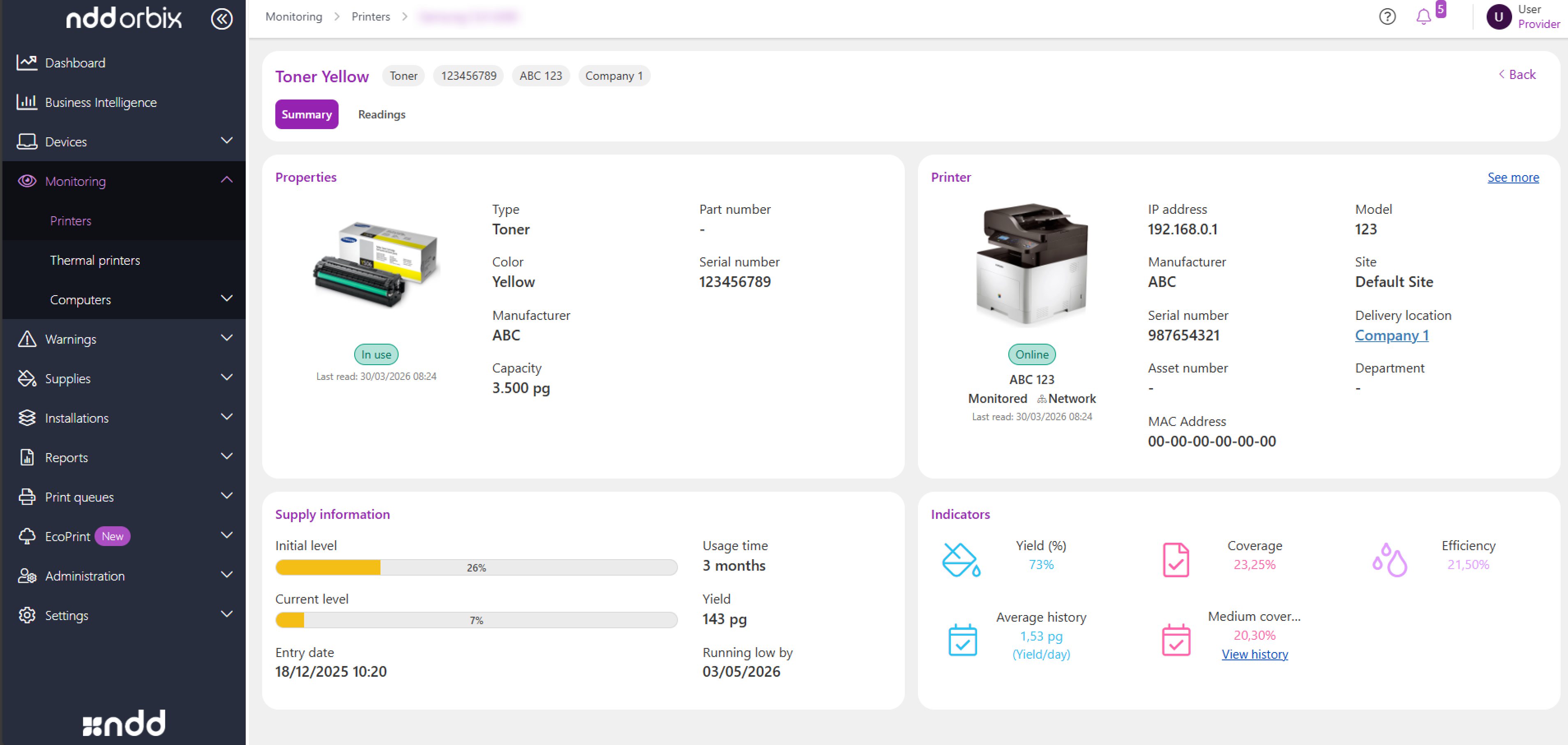
The data collected is listed in indicators that assist in decision making, aiming to make the operation more profitable.
-
Coverage
The coverage indicator represents the quantity of supply used on a printed page. The more ink used, the greater the coverage. Therefore, if all points on the page receive one pixel of ink, the printed coverage is 100%.
Coverage influences the printing capacity of a supply. The manufacturer usually indicates a coverage of 5%, guaranteeing 100% of the supply's capacity only if the average printed coverage is 5%.
Example
If a supply has a capacity for 100 pages:
-
With 5% coverage, it prints 100 pages.
-
With 10% coverage, it prints 50 pages, as it is using twice the amount of ink suggested by the manufacturer.
This indicator is crucial for the organization's profitability, because the more ink is used, the less the supply yields, resulting in more frequent replenishments. With the coverage indicator, you can monitor yield and adopt strategies to improve the profitability of the operation, such as including contractual clauses for coverage ceilings (in order to charge additional values when this is reached) and the relocation of printers with high coverage to more profitable equipment.
-
Efficiency
The efficiency indicator complements the coverage analysis, representing the efficiency of supply use.
Example
If a supply has a capacity of 100 pages:
-
With 10% coverage, it prints 50 pages and the efficiency will be 50%, indicating that it yielded only half of what was expected.
-
With 2.5% coverage, it prints 200 pages and the efficiency will be 200%, indicating that it printed twice as much as expected.
Like coverage, this indicator allows you to evaluate printer usage. If a customer has a printer with high supply costs and it is printing at 50% efficiency, you may consider replacing it with a lower-cost printer to reduce replenishment expenses.
-
Yield
The yield indicator complements the efficiency indicator, representing the percentage of available supplies used.
Example
If a supply enters the printer at 50% level and leaves at 0%, the yield was 100%, as all the ink was consumed.
On the other hand, if the supply enters with 100% and leaves with 75%, the yield was 25%.
This indicator is essential for monitoring supply consumption and assisting in the management of supplies, as well as enabling billing for waste.
-
Average pages printed per day
The indicator shows the average quantity of pages printed daily on the printer, providing an understanding of the consumption profile of the devices. This information is essential for the relocation of printers and to predict the end date of a supply.
-
Running low by
The running low indicator shows when supplies will run out, helping with replenishment planning. With this indicator, you can send supplies at the right time, preventing printers from going down.
Stock and delivery locations
Stock management represents a significant evolution in supply chain management by providing a more structured, predictable, and data-driven replenishment model.
By introducing delivery locations as controlled stock points, NDD Orbix moves beyond simply monitoring consumption and begins to organize logistics operations in an integrated manner, linking actual consumption, stock availability, and future needs into a continuous flow.
This approach addresses one of the main challenges facing outsourcing providers: the lack of visibility and control over where supplies are, when they will be needed, and how they should be replenished. In practice, it reduces reliance on manual processes and emergency decisions, replacing them with planning based on indicators such as forecast run-out, days of coverage, and safety stock levels. As a result, the system anticipates demand, allows for scheduling replenishments in advance, and reduces operational risks, while also improving device availability.
Furthermore, by separating the concepts of replenishment (based on device consumption) and safety (related to minimum stock per location), NDD Orbix adds a strategic layer to supply management. This distinction allows for better balancing of stock levels, avoiding both shortages and surpluses, and providing greater control over invested capital, with more financial predictability.
The benefits are direct: reduced costs for emergency deliveries, decreased capital tied up in stock, increased logistics efficiency, and greater scalability in managing multiple customers and locations.
Supplies replenishment
Supply replenishment in NDD Orbix is essential to ensure that the organization maintains efficient and continuous operation for its customers.
Using high-tech algorithms and with unique accuracy in the market, the system calculates the quantities needed for specific periods through features such as alerts for supplies running low and forecasts, allowing for the optimization of logistics and purchasing costs. This accurate and dynamic replenishment offers comprehensive cost management and visibility into the financial health of contracts.
-
Supply running low alerts and demand generation
The system is designed to alert situations of supplies running low based on criteria such as running low by (equal to or less than 30 days), yield (equal to or greater than 80%) and level (equal to or less than 25%). These criteria are configured as default, but can be adjusted according to the organization's needs.
After the alerts are generated, they can be transformed into demands to start the replenishment process. The system offers complete automation of the supply demand life cycle, allowing for effective management, with action auditing and detailed status tracking. This ensures transparency and control over each stage, from the identification of the need to the final replenishment.
After analyzing the demands, they can be finalized (manually or automatically) or rejected.
This efficient and detailed management of demands ensures that the replenishment process occurs accurately and quickly, avoiding service interruptions and improving operational efficiency.
-
Forecasting
Forecasts were developed to accurately predict the quantity of supplies needed for printers in defined periods, ensuring greater predictability, stock control, and strategic planning.
Based on historical data, current consumption patterns, operational indicators, and available stock, the platform calculates future demand with high accuracy, ensuring continuity of operations and avoiding both shortages and excess supplies.
Forecasting is divided into two complementary approaches: purchase forecasting (view only) and scheduled replenishment (view and generate demand for scheduled supplies).
Premature exchange of supplies
Premature exchange of supplies occurs when a printing consumable (such as toner, an ink cartridge, or similar items) is exchanged before reaching a consumption level that justifies its exchange. In other words, it involves removing a supply that still has significant remaining capacity.
This behavior directly impacts operational profitability. Whenever a supply is removed with a significant residual level, part of the investment made in that supply is wasted. When replacing a supply with 50% remaining level, for example, half of its potential usage is lost. Therefore, replenishment should preferably occur when the level is as close to 0% as possible, while adhering to technical and operational criteria.
Example
The toner cartridge still had capacity to print more pages, but was replaced because the user believed it was running low or due to a “low toner” message displayed on the equipment, without checking the actual remaining level.
In this situation, it constitutes a premature exchange.
To help manage this scenario, NDD Orbix continuously monitors supply levels and automatically identifies situations where a replacement occurs before the acceptable threshold. The portal generates alerts whenever a supply is removed with a remaining level above a configured percentage (typically 20%, which can be adjusted according to the operational strategy).
These alerts allow you to identify premature exchanges and take corrective actions, such as recovering or reusing supplies, thereby reducing waste and financial losses.
Printer supplies management in NDD Orbix ensures operational efficiency and cost optimization in all printing environments. With automated processes and a proactive approach, the feature offers complete control over supplies, preventing interruptions and improving the quality of service offered to customers.